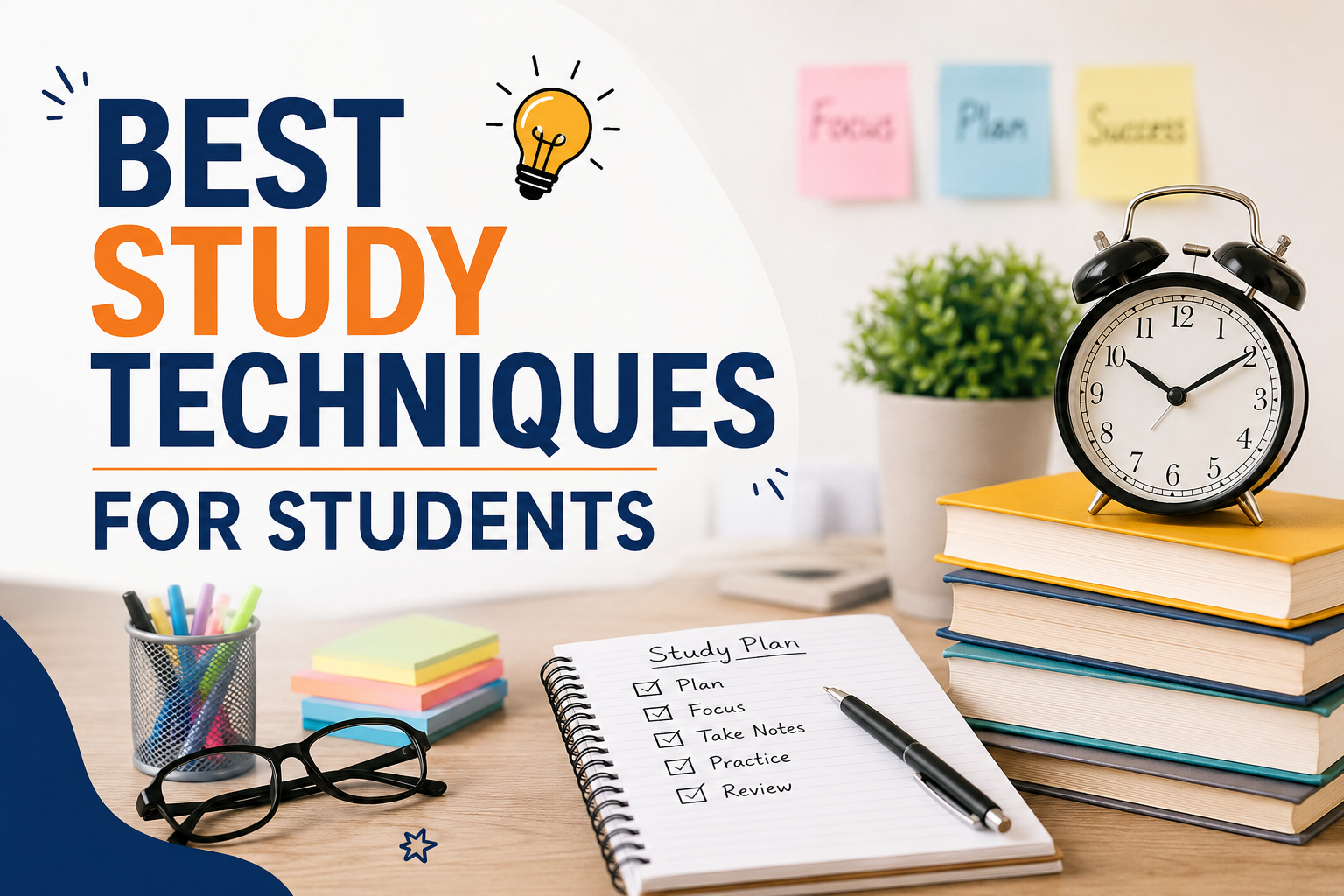
Every student wants better grades, but not everyone knows the right way to study. I have learned that studying for long hours does not always mean you will remember everything. What really matters is using smart study techniques that help you understand and retain information. Over the years, I have tried different methods, and I realized that studying with the right strategy saves time and improves results.
Many students feel stressed because they keep reading the same chapter again and again without seeing much improvement. I have been in that situation too, and I found that changing the way I studied made a huge difference. Instead of focusing on how many hours I spent with my books, I started focusing on how effectively I used those hours.
In this article, I want to share the best study techniques for students that can help improve concentration, memory, and academic performance. These methods are simple, practical, and suitable for school, college, and university students.
Understand Before Memorizing
One of the biggest mistakes students make is trying to memorize everything without understanding the topic. I believe understanding should always come first. When you understand a concept, remembering it becomes much easier.
Whenever I study a new chapter, I first read it carefully and try to understand the main idea. If something is difficult, I search for another explanation, watch an educational video, or ask my teacher. Once the concept becomes clear, memorizing important points feels natural.
Understanding also helps during exams because questions are not always asked exactly as they appear in the textbook. If you truly understand the topic, you can answer confidently in your own words.
Create a Study Schedule
Having a study timetable helps manage time effectively. Without a plan, students often waste valuable hours deciding what to study.
I like dividing my study time into different subjects. This keeps my day organized and ensures that every subject gets enough attention. A realistic schedule is much better than an overly ambitious one that is impossible to follow.
It is also important to include short breaks in your timetable. Continuous studying can make your mind tired, while regular breaks help you stay fresh and focused.
Use Active Recall
Active recall is one of the most effective study techniques I have ever used. Instead of reading the same page repeatedly, I close the book and try to remember the information without looking.
For example, after finishing a chapter, I ask myself questions about the topic. If I cannot answer them, I review only those parts that I forgot.
This method strengthens memory because it forces the brain to retrieve information instead of simply recognizing it.
Practice Spaced Repetition
Many students study everything one day before the exam, but I have noticed that this approach usually leads to forgetting information quickly.
Spaced repetition means reviewing the same material over several days or weeks instead of cramming everything into one night.
For example, after studying a lesson today, I review it tomorrow, then after three days, then after one week. This simple habit helps move information into long term memory and reduces exam stress.
Take Effective Notes
Good notes make revision much easier. Instead of copying every sentence from the textbook, I write only the most important ideas using simple language.
I also highlight keywords, important formulas, and definitions. Sometimes I use different colors to separate headings from key points. This makes my notes easy to read during exam preparation.
Writing notes in your own words also improves understanding because it requires you to process the information instead of copying it.
Study in a Quiet Environment
The place where you study has a big impact on your concentration.
I always try to choose a quiet room with minimal distractions. Turning off unnecessary notifications on my phone also helps me stay focused.
A clean study table creates a positive learning environment. When everything is organized, I spend less time looking for books and more time studying.
Set Small Study Goals
Large chapters often feel overwhelming. I have found that dividing them into smaller sections makes studying much easier.
Instead of saying I will study an entire book today, I set smaller goals such as finishing one chapter, solving ten math questions, or learning twenty vocabulary words.
Completing small goals gives a sense of achievement and keeps motivation high throughout the day.
Teach Someone Else
One technique that works surprisingly well is teaching the topic to another person.
Whenever I explain a lesson to a friend or family member, I quickly discover whether I truly understand it. If I struggle to explain something, I know I need to review that part again.
Even if no one is available, pretending to teach an imaginary class is still an excellent learning exercise.
Practice Previous Papers
Reading notes alone is not enough. Solving previous exam papers helps students understand the exam pattern and improve confidence.
I always practice old question papers before exams because they show which topics are frequently tested.
This habit also improves time management, allowing me to complete the actual exam more comfortably.
Avoid Multitasking
Many students believe they can study while checking social media or watching videos, but I have learned that multitasking reduces productivity.
Whenever I focus on only one task at a time, I understand topics more quickly and remember them better.
Keeping my phone away during study sessions has become one of my most effective habits.
Use Mind Maps
Mind maps are excellent for subjects that contain many connected ideas.
I draw a central topic in the middle of the page and connect related concepts using branches. This visual approach helps me understand relationships between different ideas.
Mind maps are especially useful for biology, history, business studies, and literature.
Take Regular Breaks
Studying continuously for several hours can reduce concentration.
I usually study for about fifty minutes and then take a short break. During the break, I stretch, drink water, or walk around for a few minutes.
These short breaks refresh my mind and improve focus when I return to studying.
Get Enough Sleep
Many students sacrifice sleep during exam season, but I believe this is a mistake.
The brain needs proper rest to process and store new information. Whenever I sleep well, I notice that I understand lessons more quickly and remember them for longer.
A tired mind cannot perform at its best, no matter how many hours are spent studying.
Maintain a Healthy Lifestyle
Good physical health supports better learning.
Eating nutritious food, drinking enough water, and exercising regularly improve concentration and energy levels.
I also avoid consuming too much junk food before studying because it often makes me feel lazy and less focused.
Stay Positive and Motivated
Success in studies depends not only on intelligence but also on attitude.
There have been times when I struggled with difficult subjects, but instead of giving up, I reminded myself that improvement comes with consistent effort.
Celebrating small achievements keeps motivation alive. Every completed chapter brings you one step closer to your academic goals.
Limit Last Minute Cramming
Studying everything the night before an exam creates unnecessary stress.
I prefer preparing gradually over several weeks. This approach gives me enough time to revise, practice questions, and strengthen weak areas.
As a result, I feel more confident and less anxious on exam day.
Review Mistakes
Making mistakes is a normal part of learning.
Whenever I answer a question incorrectly, I do not ignore it. Instead, I carefully understand why I made the mistake and learn the correct method.
Reviewing errors prevents repeating them in future exams.
Build Consistency
One of the most valuable lessons I have learned is that consistency always beats occasional hard work.
Studying for one or two hours every day is far more effective than studying ten hours only before exams.
Daily practice strengthens understanding and reduces pressure when examination time arrives.
Final Thoughts
In my experience, the best study techniques are not about studying harder but studying smarter. Every student has a different learning style, so it is important to experiment and discover which methods work best for you. Techniques such as active recall, spaced repetition, effective note taking, practicing previous papers, and maintaining a healthy routine can significantly improve academic performance.
Success does not happen overnight. It comes from consistent effort, proper planning, and a willingness to learn from mistakes. If you develop these study habits and follow them regularly, you will not only perform better in exams but also enjoy the learning process. Remember that every small step you take today brings you closer to achieving your educational goals tomorrow.